
Report
Security events by hour: what our monitoring sees
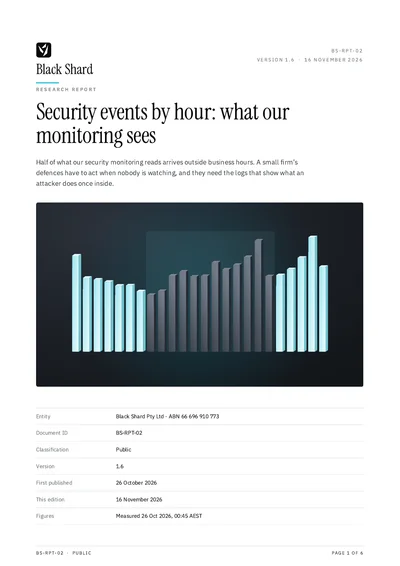
Half of what our security monitoring reads arrives outside business hours. A small firm’s defences have to act when nobody is watching, and they need the logs that show what an attacker does once inside.
- Measured 26 Oct 2026, 00:45 AEST
- First published 26 Oct 2026, this edition 16 Nov 2026
- PDF, 6 pages, 211 KB
- BS-RPT-02, version 1.6

Executive summary
Our security monitoring analysed its first 430 million security events from 1 October to 26 October 2026, counted at 00:45 AEST.
The stream is the record of what happens on every machine: which programs ran, which files they touched, who raised their privileges, what scripts executed, which domains were looked up, and who signed in from where. Most of it is routine. The line that matters is in there with the rest, and rules find it, because no person can read a stream this size.
Over the full days 2 to 25 October 2026, 49.8 per cent of events arrived outside 07:00 to 19:00 AEST, and 50.2 per cent inside it.
The stream does not keep office hours, and neither do the people who attack small firms. A business that only looks at its security during the working day is looking at half of what happens to it.
- Collect the logs that show what an attacker does after the first sign-in: process starts, PowerShell, privilege use and sign-ins.
- Let detection act at night without waiting for a person, on a short list of high-confidence threats, with every action reversible.
- Keep a phone number that is staffed when the alert fires.
Report
The figures
Events by hour of the day, AEST
When an alert fires
Clients reach us on the 24/7 incident line: 1800 370 270.
Jetstone Business, our cyber defence software, is designed for a firm with a handful of devices: the telemetry collected on the device, detection rules mapped to known attacker techniques, and a response that will act on its own against a published list of high-confidence threats, with every action undoable.
What to do
- Switch on PowerShell script block and module logging, process creation auditing and command-line capture on every Windows machine.
- Send sign-in logs from Microsoft 365 or Google Workspace somewhere they are kept for at least as long as an investigation needs.
- Keep DNS query logs: they are small, and they show which machine reached an attacker’s server.
- Write the short list of threats you would want stopped in the middle of the night without a phone call, and set your tools to act on those alone.
- Make every automatic action reversible, so the fear of a false alarm never stops you turning protection on.
- Check every day that each machine is still sending its logs. A silent machine is the one an attacker has switched off.
- Keep a number to call when an alert fires out of hours, and test that it answers.
Method
Our security monitoring analysed its first 430 million security events from 1 October to 26 October 2026, counted at 00:45 AEST. The pattern figures cover the 24 full days from 2 to 25 October 2026, in Australian Eastern Standard Time. Every hour of the day is counted the same number of times.
BS-RPT-02, published 26 Oct 2026, revised 16 Nov 2026
The full report, as a PDF
PDF, 6 pages, 211 KB. Measured 26 Oct 2026, 00:45 AEST.
More reports

Report
Known exploited vulnerabilities, July to September 2026
Additions dated 1 Jul to 30 Sep 2026, read 11 Nov 2026 · PDF, 7 pages, 241 KB

Report
Breaches loaded into Have I Been Pwned, July to September 2026
Breaches added 1 Jul to 30 Sep 2026, read 11 Nov 2026 · PDF, 6 pages, 246 KB
